What You're Actually Buying
A radon mitigation system is refreshingly simple hardware: a 3 or 4 inch PVC pipe cored into the ground beneath your slab, an inline fan rated to run continuously for a decade, a discharge above the roofline, and a u-tube manometer that shows the system is pulling suction. No filters to change, no chemicals, about $6 a month in electricity for a typical fan. It runs 24/7 and you forget it exists, which is exactly the point.
The skill is in the diagnosis, not the parts list. Before we quote, we look at your foundation type, where the footings likely divide the sub-slab into zones, whether your sump pit is a highway for soil gas, and where a pipe can run without wrecking the look of your house. A ranch on the Mesa with a clean slab is a different job than a 1920s Northside basement with a dirt-floor corner and a coal chute somebody bricked up in 1964. We've done both. Lots of both.
Our Install Process
Here's how it goes once you book:
| Step | What happens |
|---|
| 1. Walkthrough | We confirm the suction point, pipe route, and fan location with you. Photos before anything is drilled. |
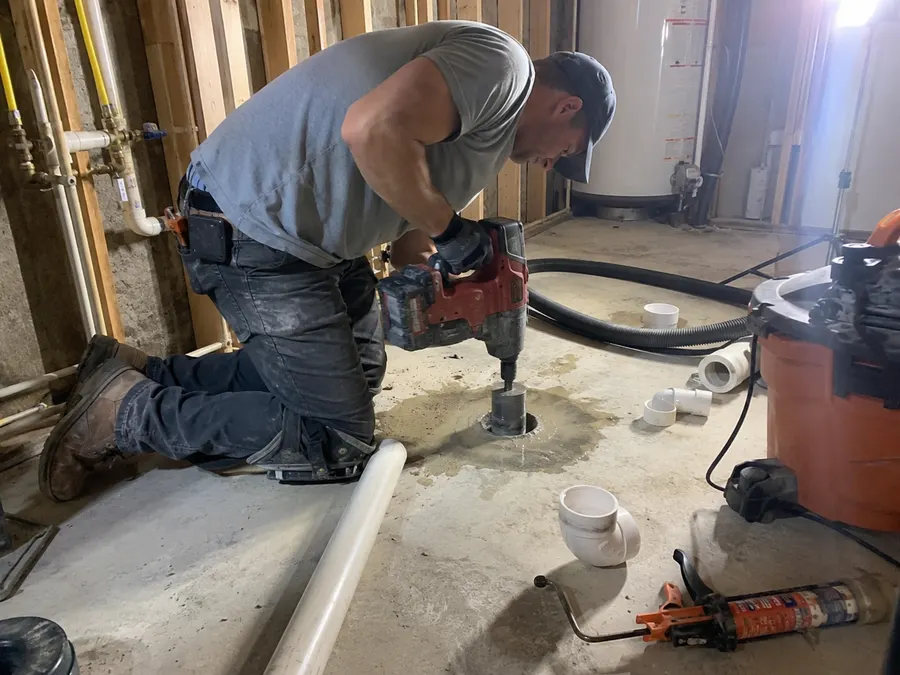
| 2. Core & dig | We core through the slab and excavate a suction pit below it, the little cavity that lets the fan draw from the whole sub-slab area. |
| 3. Pipe & fan | Sealed pipe run, fan mounted in the attic or outside, discharge terminated above the eave per EPA standards. Never under a soffit. We keep fixing those. |
| 4. Seal | Slab cracks, the slab-wall joint where practical, and your sump pit get sealed so the fan pulls from the soil, not your basement air. |
| 5. Verify | Manometer installed and labeled, system tag with our number on it, and a free 48-hour retest to prove the number. |
One thing we do that not everyone does: we put the install date and the measured vacuum on the system label. Five years from now, any tech who looks at it, ours or not, knows exactly what the system did on day one.
Why Not DIY It?
You can buy a radon fan online, and every winter somebody in Pueblo does. The failures we get called to fix are almost never the fan. They're a suction point that hit a footing and only treats half the house, a discharge that dumps gas right back at a bedroom window, an unsealed sump pit short-circuiting the whole system, or a fan mounted in a basement, which is against code because a leak on the pressure side pumps concentrated radon into the house. Colorado requires mitigation work to be done by state-licensed professionals for a reason. The pipe is cheap. Knowing where to put it is the job.
Related reading: professional radon testing, what mitigation costs in Pueblo, and crawl space systems.
Common Questions
How does a radon mitigation system work?
It changes the air pressure under your foundation. A fan pulls air from beneath the slab through a sealed pipe, so soil gas flows into the pipe instead of up through cracks into your living space. The gas vents above the roof, where it dilutes instantly to background levels. That's the whole trick: your house stops being the path of least resistance.
How long does the install take?
Most Pueblo homes are done in 4 to 6 hours. Crawl space jobs and homes needing two suction points can take a full day.
Where does the pipe run? Is it ugly?
Our first choice is always hidden: through a garage, a closet chase, or straight up through the mechanical room into the attic with the fan out of sight. Exterior runs get schedule-40 pipe painted to match your trim if you'd like, no extra charge. We photograph the planned route and show you before we drill anything.
How loud is the fan?
About as loud as a bathroom fan behind a closed door. Attic-mounted fans are essentially inaudible from living spaces. If you can hear yours humming through a wall, something's wrong, call us.
What will my level be afterward?
Guaranteed under 4.0 pCi/L, and in practice most of our installs retest between 0.4 and 1.5. The free 48-hour retest that comes with every install proves it.
Do you need radon mitigation in Pueblo? Call (719) 355-3733 or use the form above for a free, no-pressure quote.